
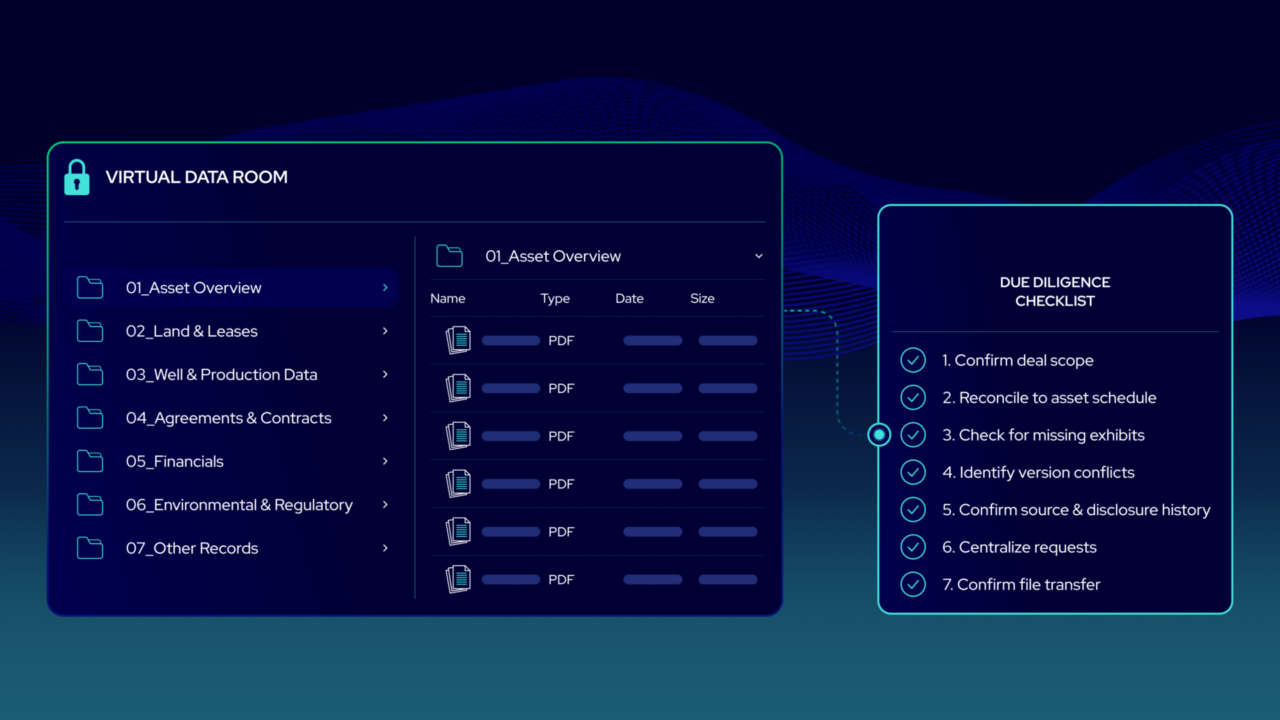
When you enter a seller’s data room, the quality of what you find will shape the rest of the due diligence. Incomplete records, missing documents, and disorganized files slow down your review, generate more requests, and make it harder to assess what you are buying.
This oil and gas acquisition due diligence checklist is for buy-side land, legal, and technical teams conducting due diligence on an oil and gas acquisition. As part of the broader oil and gas A&D process, use it to structure your review, track what you find, and catch issues before they affect your bid or your post-close integration.
1. Confirm the asset schedule matches what you are buying
Before reviewing any documents, confirm that the asset schedule reflects the deal as you understand it. Every well, lease, facility, agreement, and obligation in the schedule should be accounted for in the data room.
If the schedule is vague or inconsistent with the VDR contents, the rest of your review will be built on an unstable foundation. Gaps or mismatches between the schedule and the data room are early signals of how well the seller has prepared the package.
Ask: Does the asset schedule clearly define what is included, and does the data room appear to reflect that scope?
2. Verify every asset has supporting records
For each asset in the schedule, confirm that the supporting records are present in the data room. Leases should have associated title documents. Wells should have well files. Contracts should be accompanied by any exhibits, schedules, or amendments referenced in the body of the agreement.
This is where an oil and gas acquisition due diligence checklist helps keep the review structured. Missing records are not always a deal-breaker, but they are gaps that need resolution before closing. Document each missing item so your team can issue a targeted request rather than a broad follow-up.
Ask: For every asset in the schedule, can you find the records that support it?
3. Flag incomplete documents before binding commitments
A document that appears complete may still be missing critical supporting material. A lease may reference an amendment that was not uploaded. A contract may depend on an absent exhibit. An assignment may be tied to a schedule that does not appear in the VDR.
These gaps matter because they affect your ability to assess the asset. An incomplete lease record leaves open questions about the terms in effect. A contract missing its exhibit may have unresolved obligations. Flag every instance and request the missing material before you move to binding commitments.
Ask: Are all referenced exhibits, schedules, amendments, and attachments present for every agreement you are reviewing?
4. Identify which version of each record governs
Multiple versions of the same document create uncertainty. If the data room contains two versions of a lease, an agreement, or a well file, you need to confirm which one is current and why the other exists.
Look for unsigned drafts, superseded versions, and records that conflict with the seller’s system data. If a seller cannot clarify which version governs, that is a diligence issue that needs to be resolved in writing before close.
Ask: Where multiple versions exist, has the seller confirmed which version governs and why?
5. Confirm what was disclosed and when
As a buyer, you need a clear record of what was in the data room and when each document was made available. That record protects you post-close. If a dispute arises later about what was disclosed, you should be able to point to a documented disclosure record rather than relying on email threads or memory.
Ask the seller to provide confirmation of the disclosure record, including when documents were added and what access your team had at each stage of the process.
Ask: Can the seller confirm what documents were available to you, and when each was added to the data room?
6. Track your own diligence requests and outstanding items
Your diligence requests will accumulate across land, legal, engineering, and environmental teams. Without a central tracking system, requests to the seller can get duplicated, responses can get missed, and your team can lose visibility into what is still unresolved.
Maintain a single-tracked list of outstanding requests, organized by topic and team member, with a clear status for each item. That makes it easier to close out diligence efficiently and ensures nothing falls through before your deadline.
Ask: Is there one place where every outstanding request, response, and open item is tracked with an owner and a status?
7. Confirm how records will be delivered after close
Before signing, confirm how the seller will transfer the records and whether they will arrive in a format your team can use. A folder dump with inconsistent naming, no metadata, and no connection to your land or asset data creates a post-close cleanup project.
Ask the seller whether records are tied to specific assets, whether naming conventions are consistent, and whether the transfer can be structured to connect directly to your systems. The cleaner the handoff, the faster your team can operate on the acquired assets.
Ask: Will you receive organized, asset-linked records after close, or will post-close integration require significant cleanup?
Run this checklist before you bid
Due diligence on an oil and gas acquisition depends on the quality of the seller’s data room, but it also depends on the rigor of your own review process. Before you finalize your position, run this oil and gas acquisition due diligence checklist against what you have seen:
- Confirm the asset schedule matches what you are buying
- Verify every asset has supporting records
- Flag incomplete documents before binding commitments
- Identify which version of each record governs
- Confirm what was disclosed and when
- Track your own diligence requests and outstanding items
- Confirm how records will be delivered after close
StackDX helps buy-side teams conduct more structured acquisition reviews. When sellers use StackDX Document Management solution to prepare and share their data room, documents are organized and linked to the specific land files, wells, and assets that define the deal.
External access is controlled through project-based permissions with expiry dates, and version history is maintained to help buyers identify which documents are current. That means less time chasing basic records and more time focused on the diligence issues that require judgment. For post-close integration, organized and asset-linked records reduce the cleanup work your team faces after the deal closes.