
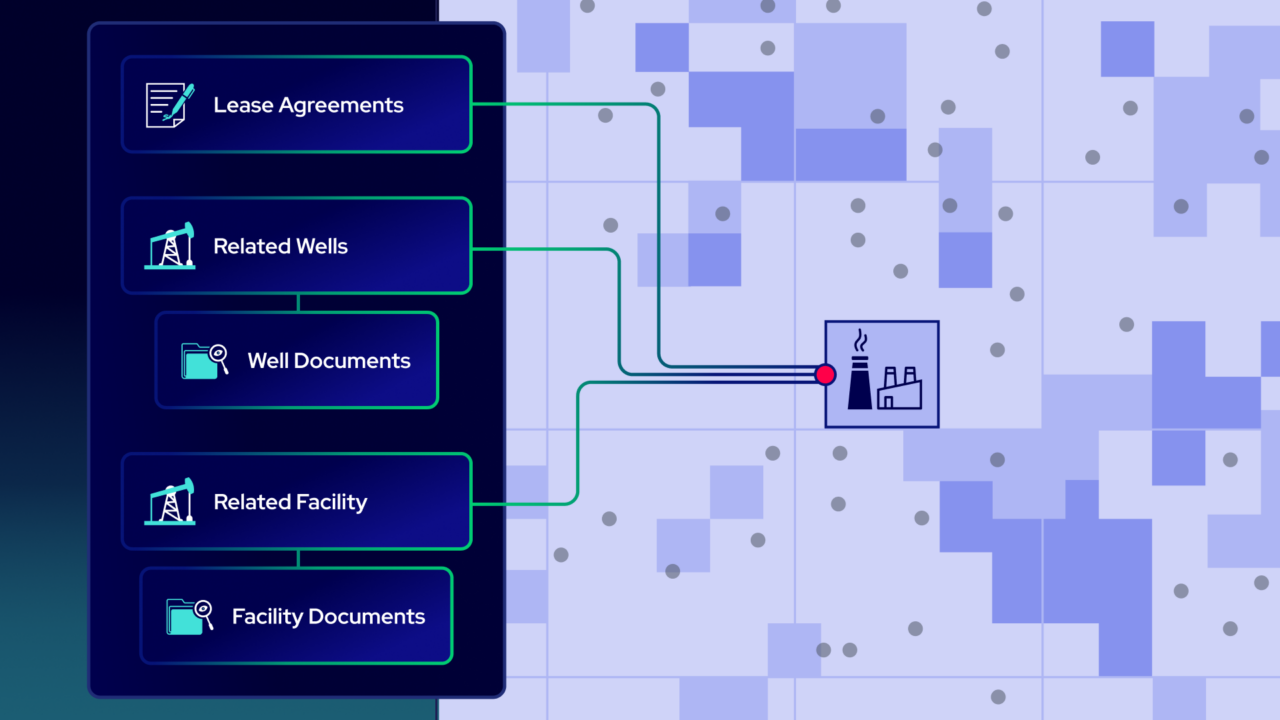
The best document management software for the oil and gas industry doesn’t just focus on where files live. It focuses on whether documents are connected to business context like wells, leases, facilities, obligations, and regulatory records. That context is what makes search reliable, audits faster, and acquisitions easier to absorb and take action on.
A few other things are also changing:
- Records and retention are getting more operational. Instead of just having a retention policy on paper, companies want software that can tag documents as records, apply retention rules automatically, and prove who did what and when (audit trail).
- AI features are table stakes now. Summaries and extraction are everywhere, but they only help if the underlying documents are structured, permissioned, and correctly cross-referenced to the right assets.
- Specific DMS is needed for upstream O&G. Document management for upstream oil and gas operations needs specific solutions that can handle files from many sources (often scanned and inconsistent), have many stake holders, must stand up in audits, and be an asset, not a liability, during A&D activity.
In this guide, we’ll compare some of the top document management software for oil & gas companies in 2026. We’ll look at the strengths and weaknesses of each and see how each tool connects documents to upstream context and scales across real-world records.
What to look for in an Oil & Gas DMS
This comparison emphasizes capabilities that matter in upstream environments:
- Linking documents to upstream objects (wells, leases, facilities, regulatory records)
- Support for upstream workflows (A&D, land obligations, well file completeness)
- AI that works inside structure and permissions
- AI that has industry awareness to properly understand what it’s reading
- Governance and audit readiness at enterprise scale
- Practicality during acquisitions: how painful is it to ingest and assimilate new records?
Non-negotiables for oil & gas document management software
Use this as a quick checklist when you’re evaluating any DMS tool.
The basics you should not compromise on
- Oil & gas-friendly taxonomy: a consistent structure that matches upstream work (land, well, regulatory, environmental, engineering, facilities) so teams file and find documents the same way.
- Modern OCR, auto-classification, metadata extraction: especially for scanned PDFs and mixed-quality files that can read handwritten notes and not-so-great copies
- Object-based linking: documents tied to wells, leases, projects, facilities (not just folders)
- Advanced search: full text plus metadata filters (and ideally search by related objects)
- Versioning and audit history: what changed, who changed it, when
- Records management and retention controls: aligned to standard records management principles
- Integrations: land system, well master, public/regulatory data, plus migration tools
- Implementation support + acquisition onboarding: fast bulk ingestion and cleanup (migration, OCR, deduplication, metadata mapping, human QA validation) so acquired docs are usable and linked to the right wells and leases quickly.
- True upstream system integration (not folder sync): if it only mirrors a drive structure, you will inherit the same chaos
Shortlist: top document management software options for oil & gas (2026)
1) StackDX — best for upstream land & well files tied to systems of record
StackDX is built to manage leases, well files, and regulatory documents in one platform, with documents linked back to upstream systems of record. It includes a native mapping view, so teams can browse assets and related documents by location on an interactive map. It’s also designed for post-acquisition reality: bulk ingestion, deduplication, gap detection, and validation of land and well record completeness.
Compared to most generic DMS solutions, StackDX starts from the “structured data side” and brings documents in. Many alternatives start as document systems first, then try to bolt on oil & gas concepts and integrations later. That difference shows up when you need repeatable workflows across land, wells, and facilities, not just a better folder tree.
Best for: teams that want documents tied directly to wells and land, with repeatable upstream workflows.
2) Quorum (Dynamic Docs) — best if you’re already standardizing on Quorum’s upstream suite
If Quorum is already your core upstream platform, the basic features of Dynamic Docs can be the most natural document layer. It uses industry taxonomies and is positioned to support documents across the upstream lifecycle.
Best for: Quorum-first organizations that want a consistent ecosystem.
3) M-Files (Energy) — best for meta document control and compliance automation
M-Files is a strong fit when your main goal is meta governance and process automation, and you’re comfortable designing a structured approach around it. It’s ultimately a general-purpose DMS, with oil and gas requirements layered in through configuration rather than built into the product’s core.
Best for: organizations that want heavy metadata discipline and compliance automation.
4) OpenText (Document Management / ECM) — best for large enterprises standardizing enterprise content management
OpenText is classic enterprise content management. It is strong on governance and regulated environments, but implementations are often time-instensive. It can be a good choice when governance, records management, and enterprise-wide standardization are the top priorities.
Best for: large enterprises that want enterprise-grade governance, even if rollout takes longer.
5) Microsoft SharePoint — best for Microsoft-native shops that want baseline governance (and “working files”)
SharePoint is widely used, especially for collaboration on Office documents. Most users are familiar with its folder structure, similar to shared network drives. The tradeoff is that SharePoint does not naturally understand upstream objects like wells and leases. You can build structure, but it usually takes more manual architecture, and it often fragments by team or dataset.
Best for: Microsoft-native environments that want active collaboration and baseline controls. If documents must be managed as formal records (retention, legal hold, audits), SharePoint alone often isn’t enough.
6) Thomson Reuters Document Intelligence (formerly ThoughtTrace) — best for contract and lease analytics at scale
Thomson Reuters Document Intelligence is primarily about AI-powered analysis of contracts and documents. It is widely associated with land use cases and contract analytics. The key point: tools in this category often excel at extraction and review, but they are not always full lifecycle document management systems.
Also worth noting: many contract analytics tools focus heavily on PDFs, and can be weaker on the wider mix of upstream file formats (i.e. Excel, LAS, TIFFs, etc.).
Best for: land-heavy teams where contract analytics is the primary need.
7) Synergis Adept — best for engineering drawing and controlled document scenarios
Adept is built for controlling engineering drawings and technical documents, with strict versioning and revision control. It’s usually not the best fit for land files or A&D workflows.
Best for: engineering, maintenance, and drawing control as the core use case.
8) Enerpact WellFiles — best for “electronic well file” focused needs
WellFiles is positioned specifically for well-related documents across the well lifecycle. If your scope is mostly “electronic well file” management, this type of tool can be a straightforward fit.
Best for: teams focused primarily on well file organization and access.
A note on AI-only extraction vendors
You will also see tools that are primarily AI extraction and analytics, or are used for niche workflows (not document management), similar in category to contract analytics tools. Examples often mentioned include Parse AI, Infersoft, Rowland, and TitleMind. These can be useful for targeted extraction, but they typically lack full governance, lifecycle controls, and cross-team workflows.
Comparison table: O&G Document Management Software
| Platform | Best for / Ideal team | O&G taxonomy support | Well / land object linking | AI indexing / extraction | Records / retention controls | Typical implementation effort | Map |
|---|---|---|---|---|---|---|---|
| StackDX | Land + wells tied to systems of record; post-acquisition cleanup | High | High | High | Medium – High | Medium | Yes – native asset map |
| Quorum (Dynamic Docs) | Quorum suite users standardizing upstream lifecycle docs | High | Medium – High | Medium | Medium | Medium | No native map |
| M-Files | Metadata-driven governance and compliance automation | Medium | Medium | Medium | Medium – High | Medium – High | No native map |
| OpenText | Enterprise ECM and regulated governance at scale | Medium | Low – Medium | Low – Medium | High | High | No native map |
| SharePoint | Microsoft-native collaboration + baseline governance | Low – Medium | Low | Low – Medium | Medium | Medium | No native map |
| TR Document Intelligence | Contract and lease analytics (often land-heavy) | Medium | Low | High (analytics) | Low – Medium | Medium | No native map; optional Maps/AGOL integration |
| Synergis Adept | Engineering drawings and controlled docs | Medium | Low | Low | Medium | Medium – High | No native map |
| Enerpact WellFiles | Electronic well file management | Medium | Medium | Medium | Low – Medium | Medium | No native map |
Quick decision guide
If you want a fast “start here,” use this:
- Choose StackDX if you need documents tied to wells and land with repeatable upstream workflows, especially through acquisitions.
- Choose Quorum (Dynamic Docs) if you’re standardized on Quorum’s application, and are currently satisfied with Dynamic Docs.
- Choose OpenText if governance, records management, and enterprise controls are the top priority.
- Choose SharePoint if collaboration on working documents is the main need, your document volumes are manageable, and you’re most familiar with network drive structures.
- Choose Thomson Reuters Document Intelligence if contract analytics is the primary use case (often land-led).
- Choose Synergis Adept if engineering drawings and controlled maintenance documentation are the core requirement.
- Choose Enerpact WellFiles if your main scope is well file management.
Why Oil & Gas Teams Choose StackDX for Document Management
The best document management software for oil & gas in 2026 is the one that connects documents to the way upstream teams actually work. That usually means linking files to wells, leases, facilities, and obligations, then making search, audit, and acquisitions less painful.
Use this guide as a starting point: narrow the field based on your top use cases (land, well files, engineering control, contract analytics, enterprise records), then dig deeper on the few platforms that match your environment and priorities. When you do, focus on how quickly each system can organize and connect real upstream records.