
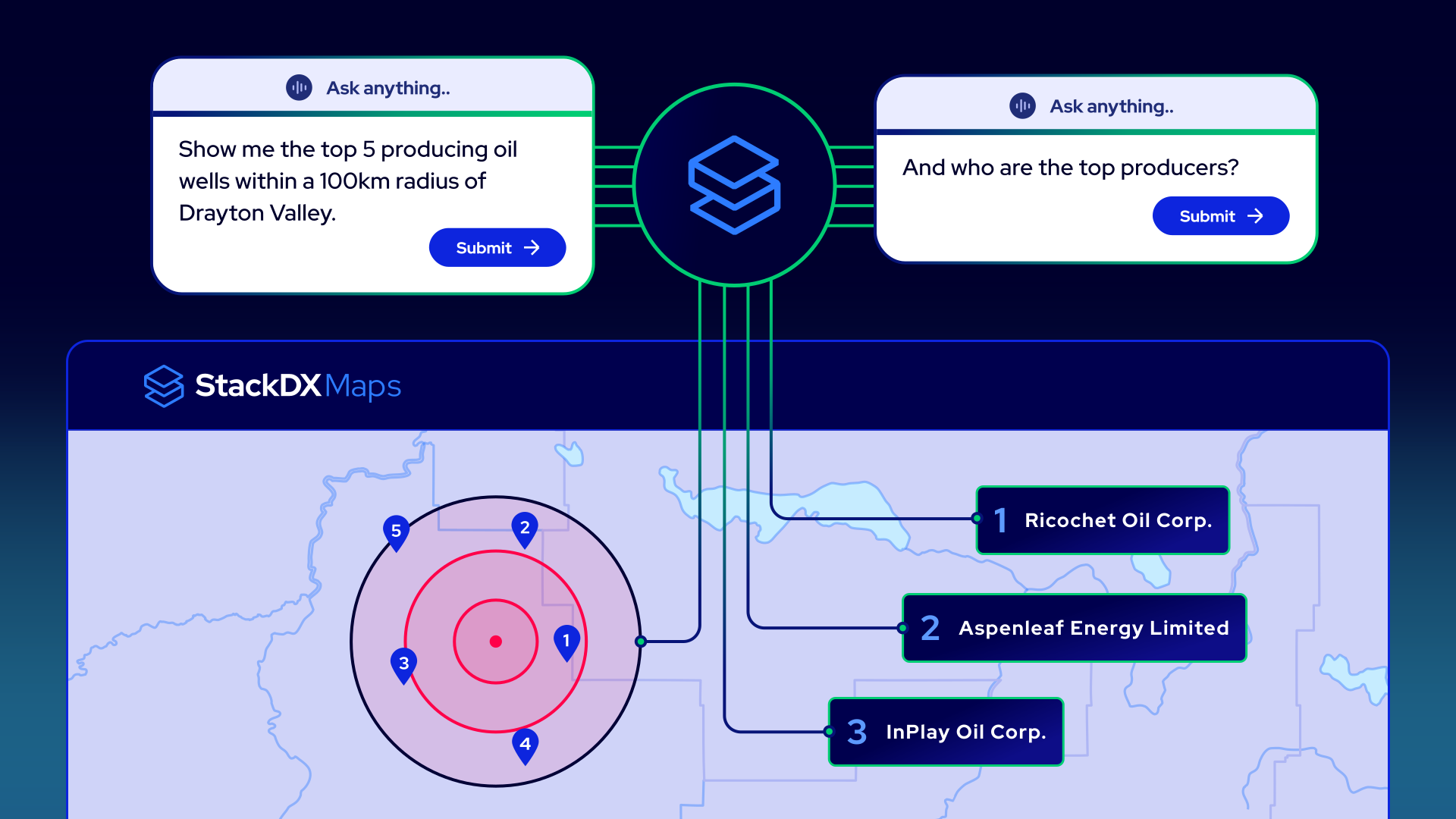
Think of StackDX AI like having a very fast analyst who’s read every oil and gas document ever written and can instantly cross-reference your company’s records. Use it to find a specific well on one of your maps. Use it to pull up a royalty clause. Use it to do your job faster.
The AI problem in oil and gas
MIT’s State of AI in Business Report 2025 found that 95% of generative AI projects fail to deliver measurable business value. That means despite 30-40 billion dollars in investment, only 5% of AI pilots actually improve productivity, accuracy, or decision-making in a meaningful way. Many AI solutions never make it past the pilot because they hallucinate and don’t improve over time or integrate into workflows well.
The same problems show up in oil and gas. Generic large language models aren’t fine-tuned to deal with leases, wells, or contracts, so the answers they spit back are often wrong or incomplete. Because they can’t reliably point back to the source, teams end up checking the documents themselves (which defeats the purpose of using AI).
And right now, there’s a flood of “AI for oil and gas” claims. Everyone seems to have a model, or is rushing to build one, so it’s easy to feel like AI is becoming a commodity, and hard to tell what will provide real value. For operators making high-stakes decisions, that uncertainty is unsettling.
StackDX offers the trusted AI in the storm. Our model has cut its teeth on 50M+ oil and gas documents and data, so it understands how to categorize, index, and extract metadata with a level of accuracy not found in generic AI models. By connecting to your land systems and public data, it can trace back to every answer. And because it’s built into the StackDX platform, you can use it while completing your daily workflows.
What StackDX AI actually does
StackDX AI delivers three core workflow layers that reshape how you handle documents, maps, and data. Think of them as building blocks: you start with answers in a single file, move into spatial queries on the map, then scale across datasets:
1. Ask your documents questions, get instant answers
Open any lease, agreement, or report in StackDX and ask it a question in plain English, just like you would in ChatGPT or Google. StackDX AI can summarize long agreements, pull out key details like royalty deductions or surface use terms, and even track the same clause across your entire library.
Examples:
- Ask a lease agreement: “Are there restrictions on assigning the lease? Ex: ROFRs”
- Ask: “Are there royalty deductions for transportation, processing, marketing?”
- Ask for a completion report: “Were there any casing deformities or fish encountered? Note depth and if milled out.”
2. Talk to your maps to visualize what matters
You don’t need filters or GIS syntax. Instead, you can describe the well, lease, or activity you’re looking for, and StackDX AI will visualize it for you directly on your maps. Because the logic is shown step by step, you can see exactly how AI got the answer.
Examples:
- “Show all of the Montney wells drilled in 2024 licensed by ARC, Tourmaline, and Ovintiv.”
- “Who are the top oil producers within a 100km radius of Drayton Valley?”
3. Turn thousands of docs into one clean dataset
Bulk Extraction lets you apply a single prompt across your entire dataset so you can scan hundreds of mineral agreements at once, pull out the clauses you care about, and turn them into a clean, structured table in hours instead of the typical turnaround.
The same prompt can be reused across different projects, from validating royalty clauses after an acquisition to building datasets for compliance reviews. By targeting the right documents first, StackDX AI reduces errors and keeps the output focused.
Examples:
- From all lease agreements: Pull out the maximum allowable days a well on this lease could be shut in.
- From all completion reports: Pull out frac stages, total volume pumped, total rate, total proppant placed, max pressure, average pressure, and breakdown pressure.
Built with the AI guardrails that oil & gas requires
- Source traceability: Output and answers link back to the original record (inclusive of your documents or public dataset).
- Query reasoning: Provides a rationale for how it translates your questions into its technical answers.
- Targeted classification: Identifies the right files before AI runs to limit endless queries and errors.
- Private instance: Your data is safe and encrypted. It never leaves your environment or is used for training other models.
- Industry-specific: Has been trained to understand oil and gas terms, acronyms, and context.
How we’re measuring success
- People stop using the old way: How often people use AI prompts instead of traditional searches, and whether semantic search replaces manual filtering on maps.
- Time savings that add up: Time to pull information from documents (we’ve seen weeks reduced to days for bulk extraction projects).
- High accuracy with transparency: When pulling deduction clauses from mineral agreements, our models find the right details in about 92% of documents. What looks like a “miss” is often the model confirming there’s nothing there, a transparent way of showing the limits of the data.
- Measured reliability: Yes we report accuracy. We also sample and validate extractions to see where the process is consistently strong and where extra care may be needed.
StackDX AI vs. AI add-ons
Most other AI tools plug generic language models onto existing software. They lack industry context, compliance guardrails, and integration with your land and well data.
StackDX AI combines:
- Proprietary document classification and indexing
- Integration with client and public data systems
- Domain-specific training with continuous fine-tuning
- Proven track record of practical AI deployment in energy